
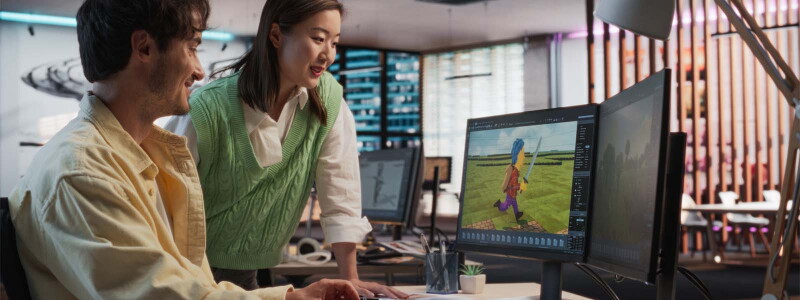
In a game development master’s program, you often build comprehensive projects, such as gameplay systems, user interfaces, or interactive levels, culminating in a polished game build. These hands-on elements are designed to help you construct a professional portfolio that showcases your collaborative and technical skills to employers.
Pursuing a graduate degree in this field means moving beyond theoretical concepts and diving into studio-style environments. You learn to work alongside peers in interdisciplinary teams, practicing the same workflows used across the game industry.
This post explores the specific coursework, collaborative processes, and capstone projects you can expect to experience throughout a game development master’s program.
Key Takeaways
- Project-based learning mirrors real-world studio collaboration and production pipelines
- You develop specialized skills through targeted master’s-level projects such as system design and user experience testing
- Engineering and design disciplines work together closely to build cohesive gameplay experiences
- A robust capstone project challenges you to collaborate with a team and deliver a polished, playable game build
- Practical coursework can translate into a standout game programming portfolio for your future career
Why Does Project-Based Learning Matter?
Graduate game projects differ significantly from traditional classroom exercises by simulating actual studio environments. Rather than focusing solely on isolated coding assignments or theoretical design papers, project-based learning requires you to collaborate across disciplines and deliver polished experiences. This approach aligns with the skills employers seek, including teamwork, problem-solving, and communication.1
When evaluating programs, look for a curriculum that emphasizes collaborative development and industry-style workflows such as sprint planning, playtesting, and iterative design. Programs that integrate hands-on learning can increase student engagement and support better alignment with career-readiness goals.2 Engaging seriously with the perspectives of others on your team helps you prepare for the interdisciplinary nature of the modern video game industry.
What Do You Build in a Master’s Program?
Throughout your coursework, you undertake a variety of specialized projects. You typically build projects focused on gameplay systems, levels and environments, economy and combat systems, and interactive user interfaces. For example, a gameplay systems project involves developing the underlying mechanics that control player abilities and in-game interactions.
You also learn to design playable spaces that guide players through challenges and narrative progression. In courses focused on systems design methods, you learn how to evaluate and simulate economic and combat systems. This systems design and game balancing work can involve automation and telemetry—the collection and transmission of in-game player behavior data—to debug and tune systems and help ensure a fair and engaging player experience.3
How Do Programming and Design Work Together?
The collaborative nature of game creation requires engineers and designers to work in tandem. Modern game production is highly interdisciplinary, with professionals in design, engineering, management, and art all contributing to the final product.4 In practice, this means a programmer building a combat system works directly with a designer defining enemy behavior and a UX specialist refining player feedback. Programs that emphasize both technical programming skills and design thinking prepare you to collaborate across these disciplines in professional environments. Online students collaborate on projects by sharing workflows and integrating their specific expertise into a unified build.
User experience (UX) design plays a critical role in bridging these disciplines. According to Nielsen Norman Group, UX encompasses all aspects of the user’s interaction with the product, meaning game UX extends beyond menus to include the full player interaction loop.5 You focus on elements of UX design, dynamic user interfaces, and feedback systems to help ensure the game communicates effectively with the player.
Furthermore, telemetry and analytics can be used in game projects to improve user experience and balance. By using remotely collected in-game behavioral data—such as session length, player drop-off points, and indicators of difficulty spikes—developers can refine pacing and difficulty.6 This data-driven approach allows programmers and designers to join forces, using player feedback and analytics to optimize the overall experience.6
What Is a Capstone Project?
A capstone project is the culmination of your graduate studies, challenging you to apply your accumulated skills in a studio-style setting. During this experience, you collaborate with a team to design, build, and polish a playable game build. This demonstrates what master’s students can accomplish when working together through a full development cycle.
The capstone experience typically spans preproduction, production, and post-production phases. During preproduction, your team establishes the game’s core concepts and pipelines, followed by the rigorous production phase where cross-discipline integration and iterative development cycles are applied. Finally, the post-production phase focuses on polish, debugging, and finalizing the product. Typical capstone deliverables may include a playable demo, a trailer, and a project postmortem.
This extensive capstone work can directly contribute to a standout portfolio and serve as tangible evidence of your ability to contribute to real game production pipelines. According to a GamesIndustry.biz crediting guide, clearly documenting your specific role in group projects like these can strengthen your professional profile, so be sure to track and articulate your individual contributions throughout the process.7
Advance Your Portfolio With DigiPen
Hands-on projects and a rigorous capstone experience are essential for preparing graduates to enter the competitive video game industry. By building complete systems and working in collaborative teams, you can develop a portfolio that demonstrates your ability to deliver polished, production-ready experiences. This practical approach helps you develop the technical and teamwork skills employers actively seek.
Advance your career by exploring the online Master of Science in Game Development program at DigiPen. Our specialized coursework helps you develop expertise in gameplay systems, software architecture, and studio-style workflows. You can gain the preparation needed to pursue opportunities in modern studios and leave with a robust body of work.
Are you ready to take the next step in your professional journey? Learn more about our admissions requirements. If you have questions about the application process, please contact DigiPen Online or schedule an appointment with an admissions outreach advisor today.
- Retrieved on October 22, 2026, from www.naceweb.org/career-readiness/competencies/career-readiness-defined
- Retrieved on October 22, 2026, from aacu.org/trending-topics/high-impact
- Retrieved on October 22, 2026, from gameanalytics.com/blog/what-is-game-telemetry
- Retrieved on October 22, 2026, from pinglestudio.com/blog/key-roles-in-a-game-development-team-2024-edition/
- Retrieved on October 22, 2026, from nngroup.com/articles/definition-user-experience
- Retrieved on October 22, 2026, from dl.acm.org/doi/full/10.1145/3743049.3743070
- Retrieved on October 22, 2026, from gamesindustry.biz/a-guide-to-properly-crediting-game-workers-and-why-it-matters